
Weekly Crypto Break June 26

Weekly Newsletter
5 min read time
|Updated: 2026-06-26
This week, the
crypto asset market was shaped by Ethereum treasury strategies, stablecoin reserve management, and multichain stablecoin infrastructure. SharpLink’s first ETH purchase after an 8-month pause showed that institutional Ethereum accumulation strategies remain active. Invesco’s plan to launch a tokenized money market fund for stablecoin issuers highlighted how reserve management is becoming more integrated with onchain finance. USDT0 surpassing 100 billion USD in transaction volume also pointed to strengthening demand for multichain stablecoin usage.
SharpLink Makes Its First ETH Purchase in 8 Months
Ethereum treasury company SharpLink purchased 5,000 ETH, worth approximately 7.85 million USD, as ETH fell toward its lowest levels of 2026. According to Arkham data, a wallet linked to SharpLink received 5,000 ETH from FalconX on Thursday. The company’s previous ETH purchase through FalconX had taken place around 8 months earlier.
This purchase suggests that SharpLink’s ETH accumulation strategy may be gaining momentum again. The company currently holds a total of 876,285 ETH and ETH equivalents, including staking rewards and active purchases. SharpLink shifted toward the Ethereum treasury company model in June 2025, with Consensys co-founder Joseph Lubin joining the board as chairman.
Why it matters SharpLink’s return to ETH purchases despite weakness in ETH price shows that the long-term accumulation approach in institutional Ethereum treasury strategies continues. This development also indicates that while price pressure remains on Ethereum, some institutional players continue to monitor expectations around tokenization, regulatory clarity, and a potential recovery in risk appetite.
Invesco Plans Tokenized Money Market Fund for Stablecoin Reserves
Invesco, which manages 2.45 trillion USD in assets, filed an updated application with the SEC to launch a new onchain money market fund focused on reserve management for stablecoin issuers. Planned under the name Invesco Stablecoin Reserves Onchain Fund, the fund is expected to be added to Invesco’s Short-Term Investments Trust portfolio.
The fund aims to maintain a 1 USD net asset value by investing in short-term, high-quality assets such as US Treasury bills, repo agreements, and cash-like instruments. Invesco plans to use Superstate as a sub-transfer agent to tokenize fund shares on selected public
blockchains.
This structure is designed to help stablecoin issuers manage their reserves through compliant, liquid, and yield-generating assets. Invesco’s move follows similar steps by major financial institutions such as BlackRock, Franklin Templeton, JPMorgan, Goldman Sachs, and State Street in the stablecoin reserve and tokenized money market fund space.
Why it matters Invesco’s move shows that reserve management in the stablecoin market is increasingly becoming an institutional product category. For stablecoin issuers, the focus is no longer limited to the safety of reserve assets; liquidity, compliance, transparency, and onchain accessibility are also becoming critical. For this reason, tokenized money market funds stand out as one of the clearest bridges between the stablecoin ecosystem and traditional finance.
USDT0 Surpasses 100 Billion USD in Transaction Volume
Tether-backed omnichain
stablecoin solution USDT0 surpassed the 100 billion USD milestone in total transaction volume. According to the project team, USDT0 reached this level in less than 530 days since its launch in January 2025, standing out with its rapid growth among stablecoin infrastructure solutions.
USDT0 is positioned as a stablecoin solution backed 1:1 by USDT and designed to be used more easily across different blockchain networks. According to its documentation, USDT0 is currently live with native integrations across 23 chains and is also accessible through 6 legacy deployments via Legacy Mesh. Its circulating supply is around 4.1 billion USD.
USDT0’s largest deployments include Arbitrum, Polygon, and the Tether-backed Plasma blockchain.
Why it matters USDT0 reaching 100 billion USD in transaction volume shows that the need for multichain infrastructure in stablecoin usage is strengthening. Rather than remaining limited to a single network or application, stablecoins are becoming more portable across exchanges, payment companies, fintechs, institutions, and different onchain applications. This points to digital dollar infrastructure evolving into a broader financial layer.
Bitcoin Price Chart
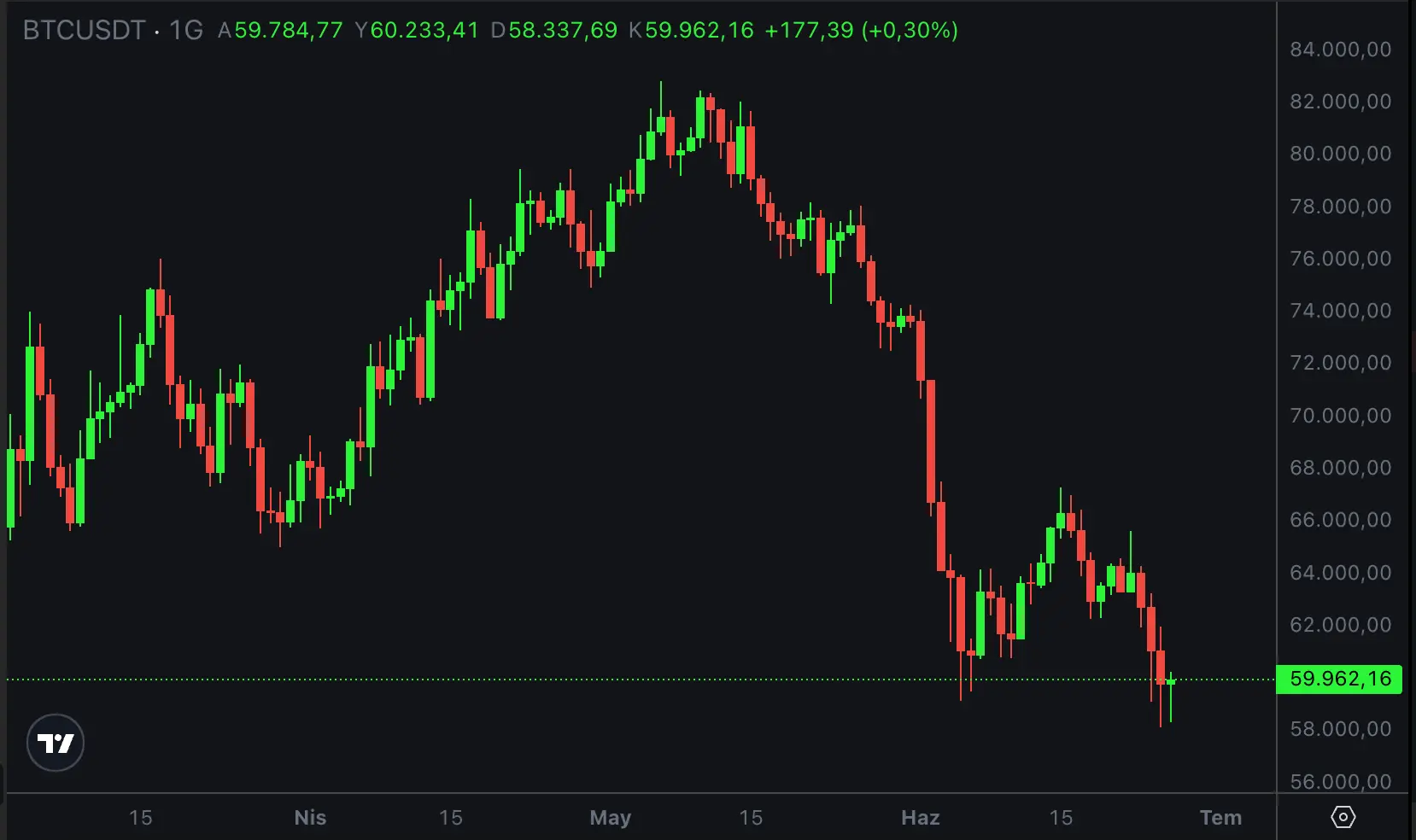
Bitcoin rose as high as 65,500 USD during the week, but momentum weakened after the pullback from this area. The weekly low was seen at 58,400 USD, while Bitcoin is trading at around 59,850 USD at the time of writing.
In this setup, the 60,000 USD level stands out as a critical near-term threshold. If Bitcoin remains below this level, the weak outlook may continue. A move back above 60,000 USD, however, will be one of the key scenarios monitored by the market. On the ETF side, total weekly net outflows of approximately 1.342 billion USD were recorded.
Ethereum Price Chart
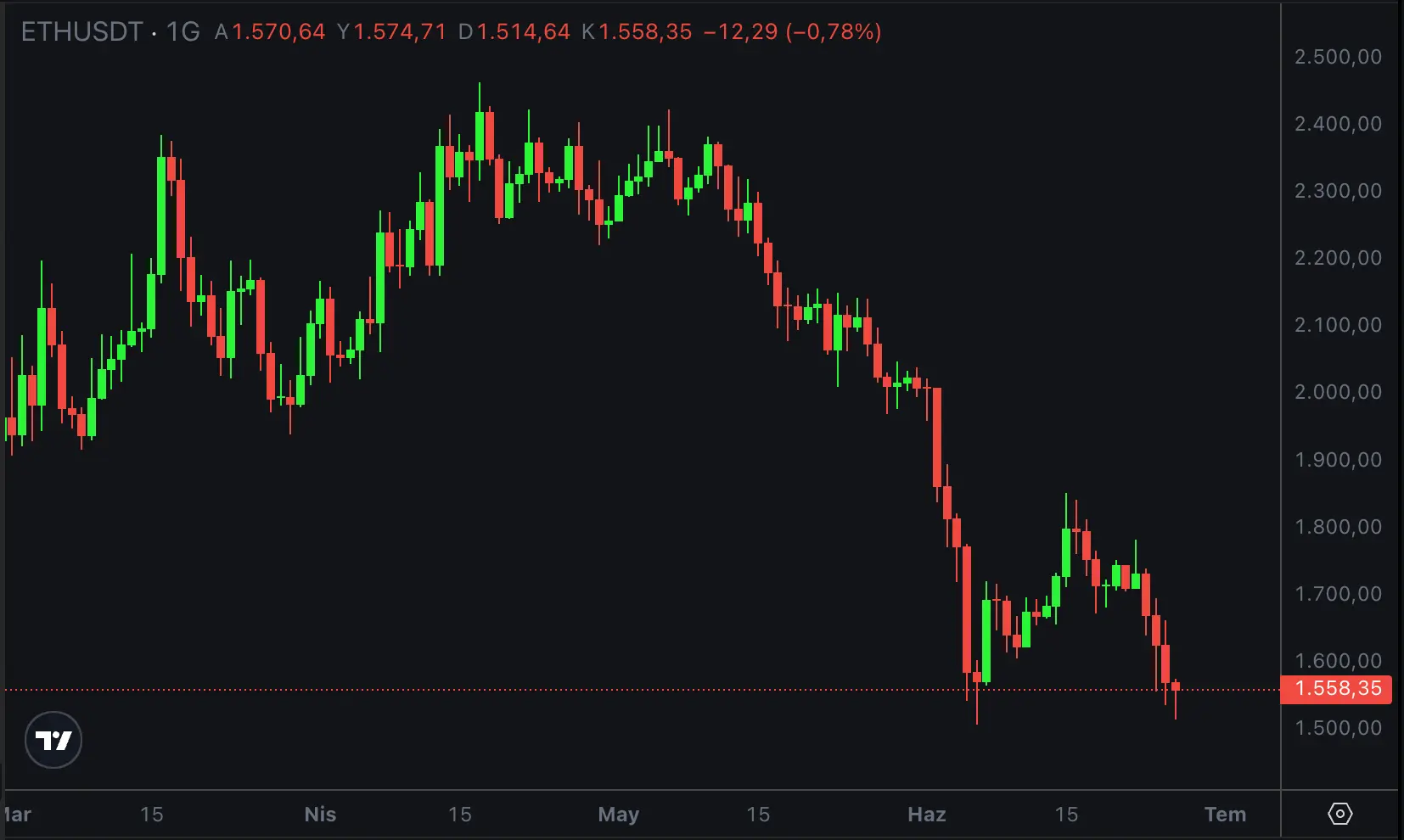
Ethereum tested the 1,750 USD level during the week but pulled back amid selling pressure from this area. At the time of writing, Ethereum is trading around 1,550 USD, very close to its weekly lows.
In this setup, the 1,500 USD level stands out as a critical near-term threshold. Whether Ethereum can maintain its position above this level will be closely watched in terms of the market outlook. On the other hand, renewed ETH purchases by institutional players such as SharpLink indicate that institutional Ethereum accumulation strategies are continuing despite price pressure. On the ETF side, total weekly net outflows of approximately 260.7 million USD were recorded.
 2026-06-26
Legal Notice
The information, comments, and evaluations contained in this content do not constitute investment advice. This content is not intended to be prescriptive in any way and is intended to provide general information. It does not constitute investment advice. CoinTR cannot be held responsible for any transactions made based on this information or any losses that may arise.
 Weekly Crypto Break July 3
Recommended
 Weekly NewsletterWeekly Crypto Break October 2 In the cryptocurrency market, new steps toward stablecoin regulation in the U.S., third-quarter fund flows in spot Bitcoin and Ethereum ETFs, the launch of the application process for the UK’s new crypto asset regime, and the impact of the U.S. government shutdown on regulatory processes were among the main topics between September 25 and October 2. The Fed opened two new draft regulations for payment stablecoin issuers for public comment. U.S.-listed spot Bitcoin and Ethereum ETFs ended the th2026-10-02
 Weekly NewsletterWeekly Crypto Break September 25 In the cryptocurrency market, spot Bitcoin and Ethereum ETF flows, blockchain-based payment infrastructure developed by traditional financial institutions, initiatives related to the international use of stablecoins, and regulatory developments in the U.S. were among the main topics between September 18 and September 25. U.S.-listed spot Bitcoin and Ethereum ETFs recorded approximately $877 million in total net inflows on September 22. Swift moved into the first use phase of its blockchain-base2026-09-25
 Weekly NewsletterWeekly Crypto Break September 18 In the cryptocurrency market, the Federal Reserve’s interest rate decision, spot Bitcoin ETF flows, a new stablecoin-focused blockchain infrastructure, and crypto asset regulations in the United Kingdom were among the main topics between September 11 and September 18. The Fed raised its policy rate by 25 basis points, while U.S.-listed spot Bitcoin ETFs recorded their largest daily net outflow since June. On the stablecoin side, Circle launched the public mainnet of the Arc network. The UK Fina2026-09-18
