
Zero Knowledge Rollup: What is ZK Rollup?

Cryptocurrency Exchange
6 min read time
|Updated: 2026-03-02
Increased transaction volume on the
Ethereum network and periodically rising gas fees are bringing scalability back to the forefront. One solution developed for this problem, Zero Knowledge Rollup (ZK Rollup), is an advanced Layer 2 technology that processes transactions off-chain and transmits their validity to Ethereum via a single validity proof. This structure reduces costs without compromising security. Recently, ZK Rollup coins in particular have attracted investors' attention due to the growing role of this technology in the Ethereum ecosystem.
So what is ZK Rollup, how does it work, and why is it so important? Let's take a closer look at the details.
What is a Rollup?
Rollups are scaling solutions that execute transactions off the main blockchain (on Layer 2) and then bundle these transactions together to transmit them to the
Layer 1 network. Processing transactions off-chain reduces congestion on the main network, lowers transaction costs, and increases the overall efficiency of the network.
In this model, hundreds or even thousands of transactions are transferred to the main chain as a single data set. Thus, Layer 1 only records summary data and verification information, and does not have to carry the entire computational load.
The rollup architecture is fundamentally divided into two types: Optimistic Rollups and Zero-Knowledge (ZK) Rollups. The key difference between these two approaches lies in how the validity of transactions is proven.
What is ZK Rollup?
ZK Rollup is a scaling solution that processes transactions outside the Ethereum main network (on Layer 2) and transmits a compressed proof of correct execution to the main chain. This system aggregates hundreds or even thousands of transactions, compresses them, generates a mathematical proof called a “validity proof,” and sends it to Ethereum. Instead of verifying each transaction individually, the main chain only checks this proof.
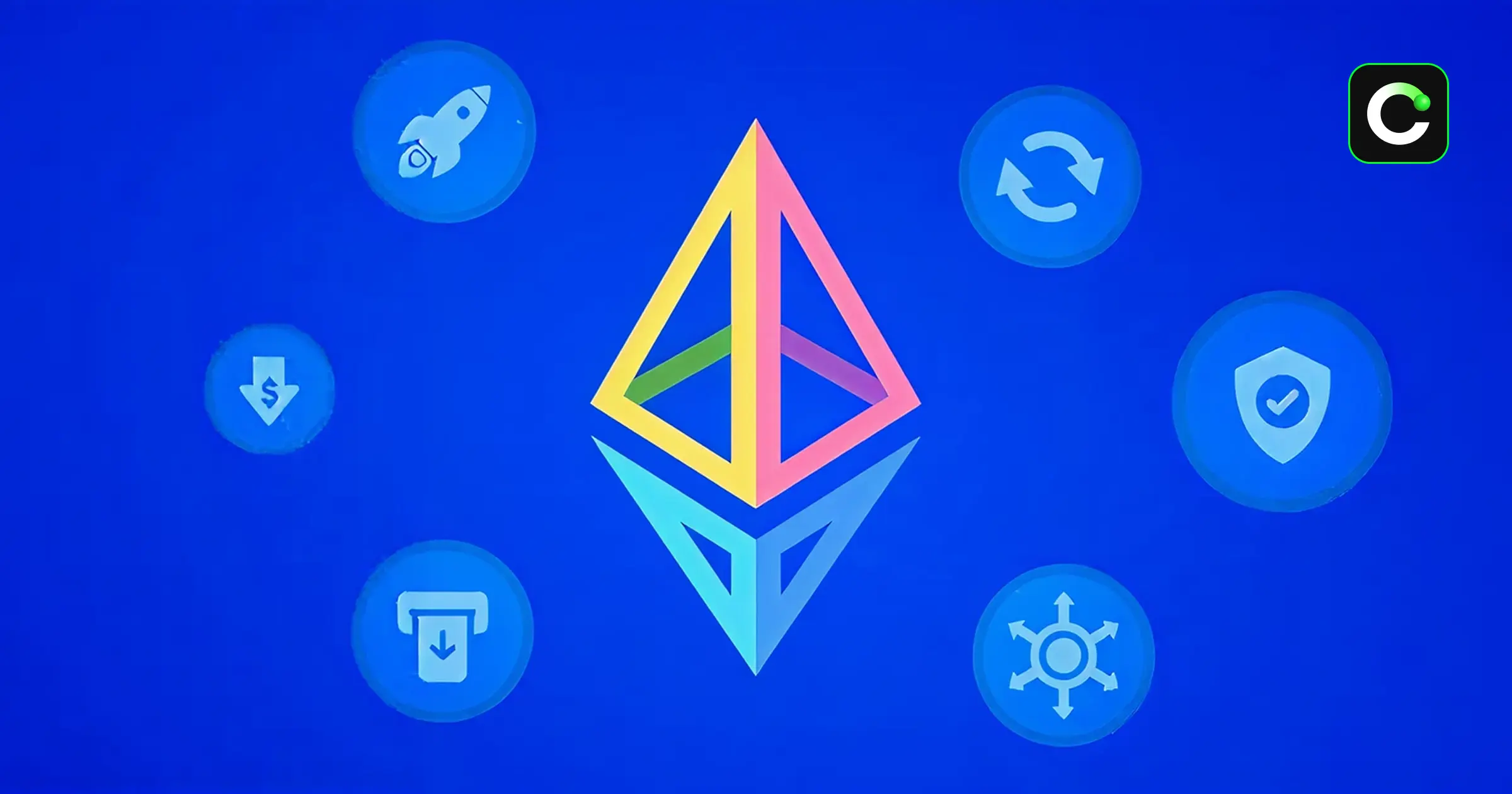
This approach is based on the principle of zero-knowledge proof. For example, you can prove that you are eligible to vote without revealing your age, or that you can cover a payment without sharing your bank balance. Based on the logic of “minimum data, maximum verification,” this structure has created a significant transformation not only in the field of privacy but also in terms of blockchain scalability.
Starting as a theoretical cryptography concept, zero-knowledge technology is now at the center of Ethereum's scaling strategy and is positioned as one of the cornerstones of its goal of high transaction capacity and low cost.
How Does ZK Rollup Work?
In ZK Rollup, transactions are executed in batches on
Layer 2, and their validity is communicated to Ethereum via a single cryptographic proof. Ethereum verifies only this validity proof instead of examining each transaction individually. Thus, thousands of transactions are finalized through a single verification process, significantly reducing the load on the network.
A simple analogy can help better understand this system. Imagine a cave with two entrances. These two entrances are connected inside by a locked door, and a secret code is required to open it. You know this code, but you want to keep it from your friend. Your friend, however, demands that you prove you know the code.
You enter the cave and randomly choose either the right or left path inside. Your friend tells you from outside which door they want you to exit through. If you know the password, you can open the door inside and exit through the desired exit. After repeating this process many times, your friend becomes certain that you know the password, but never learns the password itself. This is exactly how zero-knowledge proof works: it allows you to prove that you have information without revealing that information.
In the blockchain world, this role distribution occurs among different actors. The ZK Rollup network acts as the “prover” and performs thousands of transactions on Layer 2. It then produces a single validity proof showing that these transactions were processed according to the rules. The Ethereum mainnet acts as the “verifier,” checking this proof.
ZK-Rollup Types
ZK-Rollup solutions are fundamentally based on two different zero-knowledge proof technologies: zk-SNARKs and zk-STARKs. Both approaches enable the verification of transaction validity on the main chain through cryptographic validity proofs. However, there are significant differences between them in terms of technical structure, trust model, and cost.
-
zk-SNARKs (Zero-Knowledge Succinct Non-Interactive Arguments of Knowledge):
Produce very small proofs, and these proofs can be verified extremely quickly on-chain. This feature provides a major advantage, especially in situations where on-chain data usage must be minimized, such as on networks like Ethereum. Smaller proof size means lower transaction costs. However, zk-SNARK systems require an initial setup process called “trusted setup.” If the parameters generated during this phase are compromised, the security of the system may be at risk. Despite this, zk-SNARK-based ZK-Rollups are quite common due to their high efficiency. Today, projects such as zkSync, Polygon zkEVM, and Linea use this technology.
-
zk-STARKs (Zero-Knowledge Scalable Transparent Arguments of Knowledge):
Do not require a trusted setup. This makes the system more transparent and theoretically strengthens the trust model. Additionally, zk-STARKs are quantum-resistant; that is, they are expected to remain secure even if quantum computers are developed in the future. However, the proofs generated are larger in size compared to zk-SNARKs. This can increase the verification cost on-chain to some extent. One of the most significant projects adopting the zk-STARK approach is Starknet.
ZK-Rollup vs Optimistic Rollup
Both ZK-Rollups and Optimistic Rollups are Layer 2 scaling solutions designed to increase Ethereum’s throughput while reducing transaction costs. However, they differ significantly in how they verify transactions, achieve finality, and handle security assumptions.
|
Feature
|
Optimistic Rollups
|
ZK-Rollups
|
|
Verification Method
|
Fraud proofs — transactions are assumed valid unless challenged
|
Validity proofs — every batch is cryptographically proven correct
|
|
Finality Time
|
~7 days (challenge period required before withdrawals)
|
Minutes (final once proof is verified on Ethereum)
|
|
Transaction Cost
|
Low (benefits from EIP-4844 blob space)
|
Low (benefits from EIP-4844 blob space and hardware acceleration)
|
|
EVM Compatibility
|
Full native Ethereum compatibility
|
Full compatibility achieved (Type-1 and Type-2 zkEVMs)
|
|
Security Model
|
Requires at least one honest validator to challenge invalid states
|
Mathematical proofs guarantee validity — no trust assumptions
|
|
Withdrawal Speed
|
Minimum 7 days (to allow challenge period)
|
Near-instant (typically 15 minutes to a few hours)
|
On the Optimistic Rollup side, major networks include
Arbitrum, Optimism, and Base. Leading ZK-Rollup projects include Scroll,
zkSync Era,
Polygon zkEVM, Linea, and
Starknet.
While Optimistic Rollups still lead in Total Value Secured (TVS), ZK-Rollups have fully closed the compatibility gap by 2025. Developers can now deploy Solidity smart contracts directly on major zkEVM networks without learning new programming languages.
 2026-03-02
Legal Notice
The information, comments, and evaluations contained in this content do not constitute investment advice. This content is not intended to be prescriptive in any way and is intended to provide general information. It does not constitute investment advice. CoinTR cannot be held responsible for any transactions made based on this information or any losses that may arise.
 How to Open Institutional Crypto Account?
Recommended
 Cryptocurrency ExchangeWhat is a Stablecoin? 2026 Stablecoin List The sharp price fluctuations in cryptocurrency markets are driving investors toward more stable alternatives. In this context, stablecoins stand out among digital assets thanks to their structures designed to ensure price stability. Questions like “What does stablecoin mean?” and “What is a stablecoin?” are frequently asked, especially by users new to cryptocurrency. So why have these assets become so widely used? Today, the stablecoin ecosystem is no longer limited to as2024-11-24
 Cryptocurrency ExchangeWhat are Bear and Bull Markets? In financial markets, the terms bear market and bull market are often used to describe overall trends. A bear market represents periods of declining prices, while a bull market refers to rising trends. These terms are particularly important in the cryptocurrency market. But what exactly is a bear market, what is a bull market, and how long do these periods last? Here’s a detailed guide. What is a Bear Market? A bear market is a period when asset prices experience a prolonged decline, typically2024-11-24
 Cryptocurrency ExchangeWhat is Blockchain Technology? Blockchain is a digital ledger technology where data is stored on a distributed network without the need for central authority. As the backbone of cryptocurrencies such as Bitcoin, blockchain is now being used not only in the financial world but also across many different industries. Blocks record transactions, and each block is linked to the previous one, forming a chain. This structure makes data immutable, tamper-proof, and transparent. Key Features: Decentralization: Not controlled by a s2024-11-28
